 Learnful
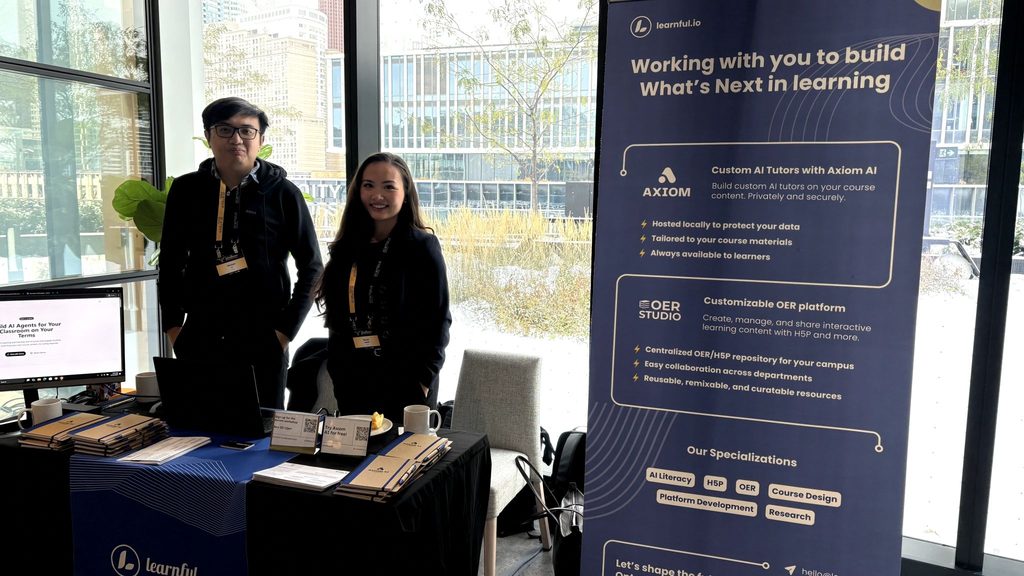
We’re writing this from The Quay, halfway through day one of eCampusOntario’s TESS 2025, Ontario’s flagship postsecondary technology and education conference, now in its ninth year. Our booth has been up since this morning, Axiom running live on a laptop for anyone who wants to poke at it, and we’ve already had more good conversations than we expected.
This year’s theme is Reinventing Education for a Resilient Future, and walking the floor, that framing feels earned rather than aspirational. Every institution here, colleges, universities, Indigenous Institutes, from across Ontario and well beyond, is wrestling with some version of the same question: what does teaching and learning look like once generative AI is simply part of the environment students work in, rather than a novelty to route around?
The conversation has shifted
A year or two ago, a lot of AI-in-education conversation at events like this centred on detection and policy: how do we catch it, how do we ban it, how do we word the syllabus. That’s not gone, but it’s no longer the center of gravity. The people stopping by our booth today are asking sharper questions: how do you redesign assessment so it’s actually testing understanding rather than output; how do you keep ownership of student interaction data instead of handing it to a vendor; how do you build something that reflects your own institution’s pedagogy rather than a generic chat wrapper.
That last one comes up constantly, and it’s close to the core of why we built Axiom the way we did. We didn’t want to build another layer on top of a commercial model that treats every campus the same. We wanted something that could sit inside an institution, generate labeled data about how students actually learn, and get better at teaching their students specifically, not a one-size-fits-all tutor.
What people wanted to see
The demo conversations have clustered around a few things:
- Assessment redesign. Instructional designers, understandably, are the most animated group at our table. The idea of multi-agent simulations, roleplay-style assessments where students have to demonstrate applied reasoning rather than recall, landed well, especially with people who’ve been quietly dreading the next wave of AI-written essays.
- Institutional data sovereignty. More than one person asked, almost cautiously, whether the platform could run on institution-owned infrastructure rather than a third-party cloud. When we said yes, that Axiom is deployed and hosted at Waterloo, several conversations noticeably relaxed.
- What actually happens to the data. People want to know if student-AI interactions are just… disappearing into a vendor’s training set somewhere. Being able to say that outcome-labeled interaction data stays inside the institution’s own pipeline is, so far, the single biggest relief we’ve watched cross someone’s face today.
The bigger picture
Sitting at a booth for a day gives you a strange, condensed view of an entire sector’s anxiety and appetite at once. What’s striking is how little of it is about AI as a threat anymore, and how much of it is about agency, institutions wanting tools that work for their pedagogy and for their data, not tools they’ve simply been handed.
That’s the gap we think there’s real room to fill: not another commercial AI tutor competing on features, but infrastructure that treats a university’s teaching philosophy and its data as things worth protecting and building on, rather than commodities to be abstracted away.
Day two starts tomorrow. More from the floor then.
The Learnful team