 Learnful
We’re excited to announce the launch of a new open educational resource: OpenTheorems, a free and open collection of interactive mathematics visualizations, built to make the intuition behind theorems visible, not just memorisable.
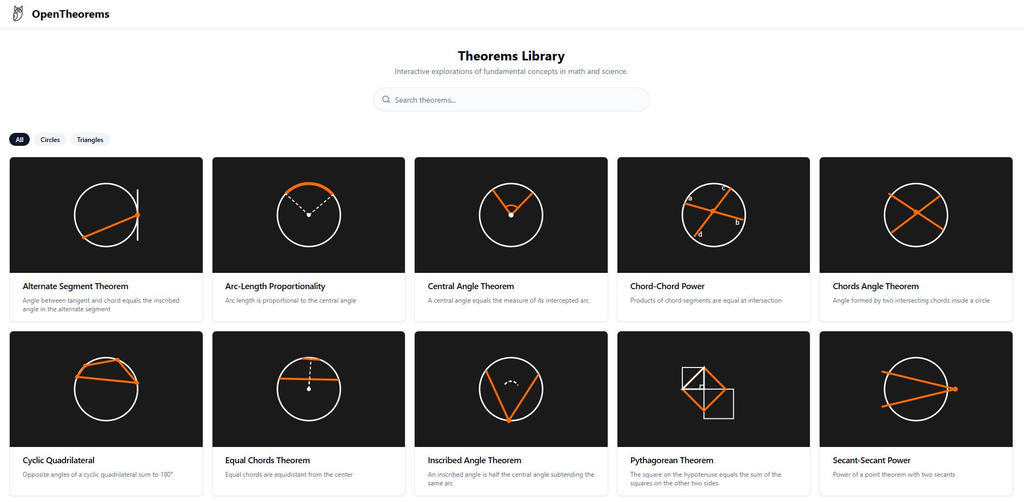
Math theorems are usually taught as static statements to memorize and then apply. You learn the Inscribed Angle Theorem, you copy down the diagram, you move on. What gets lost is the why: the moment where you can actually see a relationship holding as the underlying shapes change. OpenTheorems is our attempt to put that moment back into reach for anyone, for free.
What’s in the collection
The Theorems Library currently covers a set of core circle theorems, each as its own interactive exploration:
- Alternate Segment Theorem
- Arc-Length Proportionality
- Central Angle Theorem
- Chord-Chord Power
- Chords Angle Theorem
- Cyclic Quadrilateral
- Equal Chords Theorem
- Inscribed Angle Theorem
- Pythagorean Theorem
- Secant-Secant Power
Each one lets you manipulate the underlying figure directly and watch the relationship hold as you do. That’s the whole point: instead of reading that “the angle at the centre is twice the angle at the circumference,” you drag a point and watch it stay true.
More interactives are on the way.
Why we built it this way
OpenTheorems is AI-generated, and we don’t think that’s a footnote, it’s actually the more interesting part of the story. Each interactive in the library was generated in about two minutes. That’s not a shortcut we took to cut corners; it’s a preview of what’s becoming possible for educational content authoring generally.
As AI makes authoring easier, it also makes it easier to build more complex content and courseware than most individual educators or small teams could reasonably produce by hand. A single instructor putting together their own visual proof aids for a unit on circle geometry used to mean hours of manual diagram work, if it happened at all. That same instructor can now generate a working, manipulable interactive in the time it takes to write a slide.
That’s the shift we’re most interested in as an open education company: not AI replacing the pedagogy, but AI collapsing the cost of producing genuinely good pedagogical tools, so that “open” and “well-made” stop being in tension.
Free, open, and yours to use
OpenTheorems is released under an open license and is free to use. Browse the Theorems Library, drag things around, and see what sticks better than the textbook version ever did.
We’re releasing this during Open Education Week, which felt like the right moment. Open education isn’t just about free access to existing materials, it’s also about who gets to make new ones, and how many of them get made. If AI can lower that bar, we want to be putting things directly into that gap.
Happy #OEWeek26 and Open Education Global (OEGlobal) to everyone building in the open alongside us.
Explore the collection: OpenTheorems
The Learnful team